Are Credit Union Deposits Less Rate Sensitive In 2016 Than 2004?

3 min read

A rate sensitivity analysis is very useful when attempting to determine how a change in the Fed Funds rate will impact a credit union’s cost of funds. As we have performed these analyses this year to help clients and prospects, we were somewhat surprised to observe that a large number of credit unions did not raise their dividend rates on regular shares or drafts during the last rate cycle starting back in 2004. To further explore how common this practice was, we decided to look at the complete call report database to see if this was somewhat isolated or more universal in the industry.

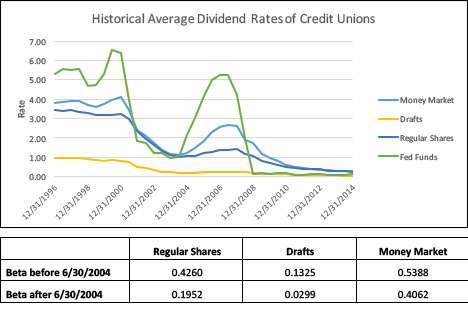
A beta, or rate sensitivity factor, displays by what percentage the deposit rate adjusts based on a given change in a driver rate—in this case, the Fed Funds rate. Based on the average rate paid by credit unions from call report data, the analysis shows the beta on deposits in the last rate cycle starting in 2004 was dramatically lower than the previous rate cycle. This was especially true for regular shares and drafts, which saw drops in the beta from 0.4260 to 0.1952 and 0.1325 to 0.0299 respectively. (See the graph below.) This would support the conclusion that industry wide, deposit rates were much less sensitive to changes in the Fed Funds rate during the last rate cycle.
Sensitivein2016

After observing some credit unions not change their regular share and draft rates at all, we would expect to have seen funds leave these credit unions to pursue higher available yields. Surprisingly, that did not occur. In fact, in further analysis, there was not even a noticeable difference in the average life of deposits during the time when the credit union did not increase rates and when the Fed Funds rate did increase. The common belief has long held if financial institutions do not pay a more competitive rate on their deposits, then the money will leave. Why then did the money stay at these credit unions when they did not raise their rates at all?

One answer may be increased attention to segmentation strategies and alternative deposit options offered by credit unions since the early 2000’s. Segmentation strategies usually allow the credit union to pay a lower deposit rate to those members who are not as rate sensitive. This is traditionally done through money market accounts. While money market accounts are becoming more prevalent at credit unions, approximately half of all credit unions report having a money market account on their call report. Good segmentation strategies should not only segment those who want a higher rate from those who are fine with a lower rate, but also segment those who want a higher rate from those who want extra services or benefits. If you have not deployed a segmentation strategy or expanded deposit options, both for rate and service, it is not too late. Deposit rates are essentially as low as they have ever been, and the best time to implement segmentation strategies is when deposit rates are down.

Another possible reason why those credit unions did not see a large outflow of deposits is because many members enjoy the services from their credit union more than a higher deposit rate. They want to stay at the credit union because of the convenience and the exceptional and friendly service, combined with new technologies they have come to expect. If the credit union is able to save money by not raising dividend rates, it may provide resources that can be spent on extra services.
In this prolonged low-rate environment, members are getting used to low deposit rates. Many financial institutions have eliminated interest-bearing checking with no plans to reintroduce interest-bearing checking when rates go back up. Based on call report data, non-interest-bearing checking appears to be the new norm, and the longer we stay in this low-rate environment, the more credit unions and depositors will be removed from expecting earnings on checking accounts.

How deposits will behave in the future and whether they remain less rate sensitive, move back into requiring higher yields, or move to other investments outside the credit union remains a significant unknown. It is possible due to the financial crisis that deposits have been temporarily less rate sensitive, and as the economy returns to normal levels, depositor expectations and behaviors may change. The recent lower rate sensitivity on deposits is no guarantee of the behavior in the next rate cycle. Conversely, depositors may have evolved and reprioritized safety, liquidity, and services over earnings. Either way, having solid segmentation strategies in place will give the credit union options to maximize opportunities and balance services with rates. Always evaluate and prepare to capitalize on the possibility that members may not expect as high of a rate as previously thought. Be careful not to quickly raise rates on deposits just because that is what you have always done or because the credit union down the street did. It is possible deposits are not as rate sensitive as they used to be.

Related/Popular Articles

As we move into 2021, the following topics might be worth discussing and considering with your management team.

Earnings

During the first half of 2020, net interest margins came under substantial pressure as market interest rates were shocked dramatically downward. Net interest margins are expected to remain under downward pressure throughout 2021 as investment portfolios continue to reprice lower and share growth continues.

One of the easiest and quickest responses to declining interest income is to address the cost of funds. Many credit unions still have room to decrease their cost of funds, as shown in the September 2020 ending period graph below.

Yield vs. Cost of FundsSource: NCUA

Delinquency

Based on the September 2020 call report data, loan delinquencies and net charge-offs remained low and were below September 2019 delinquencies. Loan forbearance and other assistance programs in place through the entirety of 2020 may have helped delinquencies. Also, certain sectors of the economy are not as impacted as others. The unemployment rate is expected to continue drifting lower in 2021. However, as the assistance programs are lifted, delinquencies and charge-offs are expected to increase as unemployment remains substantially above the years leading up to the pandemic.

Total Loan Delinquency Rates By Category

Source: MHSI Online Peer Analysis Module through September 2020

Credit Union Philosophy

Serving the underserved has always been a hallmark of credit unions, and now more than ever, there is an opportunity to do this for many credit union members. As these times have been challenging, credit unions can continue to evaluate and prioritize how to best serve members in the coming year, especially those under financial stress. Exploring how to provide service to those that are underbanked might be an opportunity. One option may include evaluating risk-based lending policies and programs, especially given the robust liquidity on most credit union balance sheets. New and alternative avenues to bolster income should continue to be explored.

Digital and Technology

As the pandemic shifts and prolongs, credit unions should evaluate if their electronic delivery channels meet members and potential members’ needs. Moving to or improving digital delivery channels should be accelerated and prioritized. Digital delivery should include evaluating loan origination and servicing channels to maximize new loan volumes. Online and remote financial services will continue to grow and may be the preferred way members access and manage their financial activities.

Balance Sheet Growth

Before the pandemic, many experts anticipated credit union loan growth to taper off but remain positive. After the first quarter of 2021, loan production became unpredictable, however, by the end of the third quarter, annualized loan growth was 6.34%. Real estate lending, driven by the abruptly lower interest rate environment, helped with the growth. Experts anticipate loan growth to be around 6.0% to 6.5% over the next 12 months as the economy recovers.

The first few months of 2021 may see strong share growth as the second round of government assistance and stimulus takes hold, and households remain reluctant to spend until signs of COVID easing and warmer weather occur. Share growth last year increased at an annualized rate of over 18% and is expected to be approximately 8.0% to 10.0% in the coming year. If double-digit growth continues, earnings sufficient enough to sustain capital will be critical. If economic conditions improve and overall consumer activity increases, loan growth and increasing long-term interest rates could counter some of the anticipated income pressures. Fortunately, the credit union industry is very well capitalized and able to ride out the adverse conditions and absorb some more growth, even if earnings are reduced. 

Several years back, I went to Mexico for a vacation. While there, I found a ceramic hand-painted frog-shaped planter that I wanted. My husband loves the hunt, and his quest began. Every time we saw a frog-planter, he would start negotiating with the vendor to get the lowest possible price. We searched for several days and would stop in different towns and check the markets while enjoying our vacation and exploring. When we found a frog, he would inquire about the price and negotiate for further discounts. After a few days and no success at getting the cost of the frog below a certain point, my husband declared, “we have hit the bottom of the frog market.”

…

Future GDP Projections

In September, the Federal Reserve Chairman spoke publicly on several occasions and reiterated that the central bank is committed to helping the economy “for as long as it takes.” He noted continued improvements in the economy, but also acknowledged a highly uncertain path ahead. The September FOMC (Federal Open Market Committee) projections are now projecting a full-year GDP decline of 3.7%. This is substantially better than their previous expectation of a 6.5% decline. However, they lowered their 2021 outlook from 5.0% to 4.0% and their 2022 outlook from 3.5% to 3.0%. Their 2023 outlook is at 2.50%.

Interest Rates and Economic Uncertainties

The FOMC also indicated that they would allow inflation to run above 2.0% on a sustained basis before any federal funds rate increases. As such, most individual members of the Committee indicated that the federal funds rate could remain close to zero through 2023. Some economists and analysts even think that we may not see an increase in the federal funds rate until 2024 or 2025. They believe that it will take up to five years for the global economy to fully recover to pre-pandemic levels.

The risks to the FOMC economic growth projections are high. Even the Chairman of the FOMC acknowledged the economic uncertainty of the path ahead. Following the sharp rebound in many economic data measures and drop in the unemployment rate, some recent measures have disappointed compared to expectations and some are indicating a recovery that is stalling. At the current time of this article, the nature of further fiscal stimulus continues to be negotiated in congress and some are not expecting a resolution until after the presidential election. Of course this only adds to the current economic uncertainty.

What is highly certain over the short to medium term timeframe is that interest rates will not likely be increasing more than just relatively minor fluctuations in the medium to long end of the U.S. Treasury yield curve. It is more likely that potential risks on the horizon could drive medium and longer-term U.S. Treasury yields even lower.

Reassessing Balance Sheet Strategy

Given the above outlook, it would certainly seem that some credit union balance sheet strategies of recent years should be reevaluated for the foreseeable future. Reassessing asset allocation strategies is possibly more relevant at the current time than at any time in the past several years. For example, the credit union may want to ask itself how much should we be redeploying assets into two to three year investment CDs given current interest rates on those maturities. If the answer is less than previous years, then what are the alternatives we can explore.

Priorities Going Forward

In exploring alternatives, the first priority for credit unions is of course serving members. Assessments and considerations could include expanding the types of loans offered, reevaluating risk based lending allocations, increasing real estate concentrations, debt consolidation programs, and loan payment support alternatives to name just a few. Secondary to the first priority are considerations such as allocations to loan participations and alternative investments. For example, should the credit union assess CUSO or similar investment possibilities. What are all of the possibilities for these type of investments that may be available to the credit union? After all, an alternative of earning five basis points at the corporate credit union with too much of assets is not likely to accomplish any priorities or goals for the credit union.

The present time and foreseeable future is a great time for credit unions to really show how they can serve and support members during these challenging times. Being there for your members is for sure the highest purpose for the credit union and always assessing ways to provide service and assistance to them will always be the credit union’s first priority. In addition and secondarily, now more than any time in recent years it may make sense to really take a deep dive into the above asset allocation assessments, considerations, and possibilities. Ideally, the best answers going forward would combine the first priority with the second to optimize balance sheet performance while best serving members.

Scroll to Top